Evaluating and Optimising Energy Performance in Non-Domestic Buildings: From Toolkits to Real-World Impact

Reducing operational energy use in non-domestic buildings is no longer optional. It’s a regulatory, environmental, and financial necessity. The 2025 CIBSE Technical Symposium presented data-backed strategies that go beyond theoretical guidance and deliver real results. 

This post breaks down insights from leading presentations and shows how tools like VEXO’s S-BMS can support building managers, engineers, and consultants in cutting energy waste and reaching net-zero targets faster.

Why Focus on Non-Domestic Building Performance? 

Key reasons:  

  • Non-domestic buildings, especially warehouses, schools, and hotels, consume significant energy across HVAC, lighting, water systems, and plug loads. 
  • Warehouses and logistics account for at least 7% of global GHG emissions 
  • Schools account for around 15% of the public sector’s carbon emissions in the UK 
  • Water systems can account for up to 24% of building energy consumption in inefficient hotel designs 
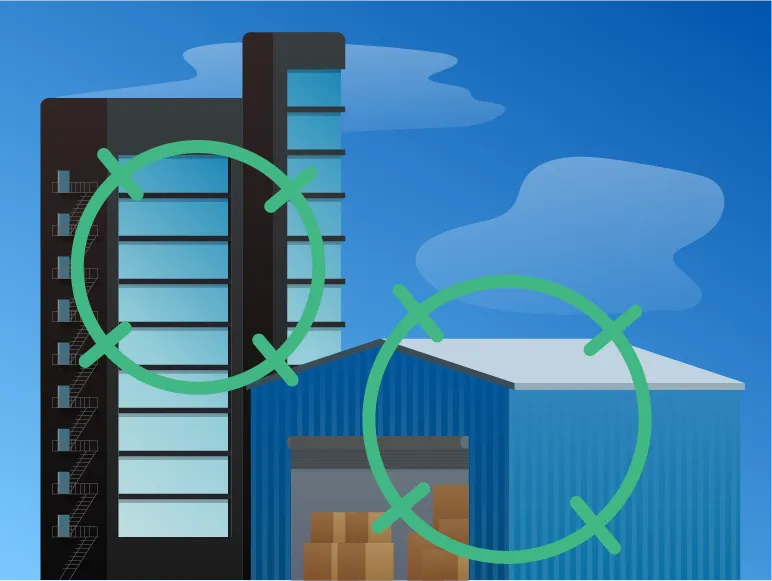
Illustration of commercial and industrial buildings with green targeting overlays, symbolizing energy monitoring or efficiency focus.

Warehouses: Designing for Net-Zero from Day One 

Jonathon Handley’s research introduced a dynamic Excel-based Net Zero Carbon (NZC) warehouse toolkit that guides early-stage design choices. It covers: 

  • 4 typologies: Self-storage, Light Industrial, Retail Pods, Retail Warehouses. 
  • Variable inputs: location, floor area, orientation, HVAC, PV sizing, U-values. 
  • Real-time energy use feedback using batch simulation data from IES VE. 

Early-stage decisions like improved insulation, lighting controls, and HVAC strategies can cut operational energy by over 30%, pushing projects toward NZC targets before construction begins. 

How VEXO Can Help 

While toolkits help during design, post-construction performance often falls short. VEXO’s S-BMS (Smart Building Management System) provides:

Icons representing real-time metering and analytics, occupancy and lighting control integration, and fault detection with continuous optimisation

This aligns with CIBSE’s TM54 framework and ensures design intent matches actual energy use. 

Schools: Bridging the Gap Between Design and Reality 


Jingxuan Yang’s presentation exposed a persistent issue in new buildings still underperforming. Schools built under the Priority School Building Programme (PSBP) outperformed those built under the higher-funded BSF scheme, largely due to compact design, efficient systems, and better commissioning. 

Even then, a PSBP primary school showed measured gas use almost 4x higher than predicted, driven by:  

  • Unanticipated server room loads 
  • Extended heating schedules 
  • Ventilation leakage 
  • Control issues during non-term times 

S-BMS as a Correction Layer

Using VEXO’s S-BMS, schools can: 

  • Adjust heating setpoints and schedules remotely 
  • Monitor unexpected usage from IT and kitchen equipment 
  • Benchmark performance using historic data 
  • Alert facilities teams when systems deviate from optimal ranges 

Even without refurbishment, such operational tweaks can deliver double-digit savings. 

Hotels and Water Systems: The Hidden Energy Sink

Thuy Bich Thuy Nguyen’s case study of a 10-storey hotel highlighted water systems as a major energy consumer with up to 24.1% of total building energy in traditional designs. 

The sustainable design alternative used: 

  • Air source heat pumps 
  • Efficient booster pumps with VSD 
  • Hot water storage optimisation 
  • Zone-based pressure control 

Result: a 30% energy saving and reduced pipework, labour, and maintenance costs.

S-BMS for Plumbing and DHW Monitoring

VEXO’s S-BMS extends beyond HVAC and lighting:

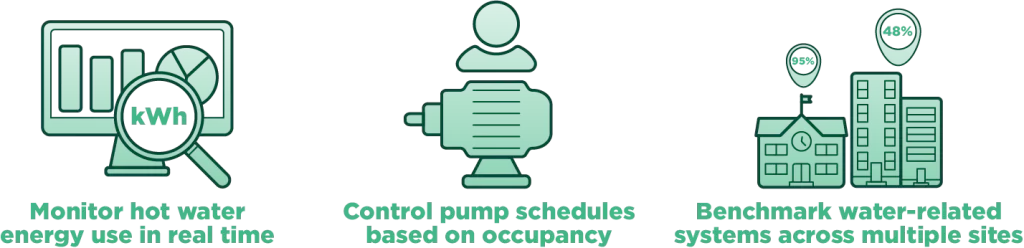
Water energy management features including real-time hot water monitoring, pump scheduling based on occupancy, and benchmarking across multiple sites

Adding these features avoids performance drift and keeps maintenance efficient. 

Common Themes Across All Buildings 

  • Energy modelling isn’t enough – real-time data and controls are essential to meet performance goals. 
  • Simpler, compact, and well-managed systems outperform more expensive, complex ones. 
  • Ventilation and background loads (e.g. servers, pumps) are often overlooked in standard energy modelling. 
  • Post-occupancy evaluation is critical – design assumptions frequently miss real-world usage. 

VEXO’s Role in Energy Optimisation 

VEXO’s S-BMS is already deployed in schools, offices, and industrial facilities across the UK. Clients report: 

  • Up to 25% reduction in energy consumption within the first year 
  • Improved building comfort and reduced occupant complaints 
  • Faster fault detection, reducing unplanned maintenance costs

Final Thoughts and Next Steps

If your project involves warehouse design, school operation, hotel retrofits, or portfolio energy management, passive design alone won’t close the gap. Toolkits like those presented at the CIBSE Symposium help you get started, but ongoing optimisation is what achieves long-term savings. 

Book a free demo of VEXO’s S-BMS to see how your building can run leaner, cleaner, and smarter. 

more blog posts

Scroll to Top